Insurance at the Blackjack Table: Almost Always Wrong, Occasionally Interesting
Let's get the obvious out of the way: if you're a recreational blackjack player in the United States, you should decline insurance every single time the dealer asks. Full stop. It's one of the few truly reliable pieces of advice in a game full of nuance, and no amount of gut feeling, hot streaks, or table superstition changes the underlying math.
That said — and this is the part that makes blackjack genuinely fascinating — there is a version of this story where insurance isn't the worst bet you can make. It's a narrow version, dependent on conditions most players never encounter, but it exists. And understanding why it exists teaches you more about this game than a dozen strategy charts combined.
What Insurance Actually Is
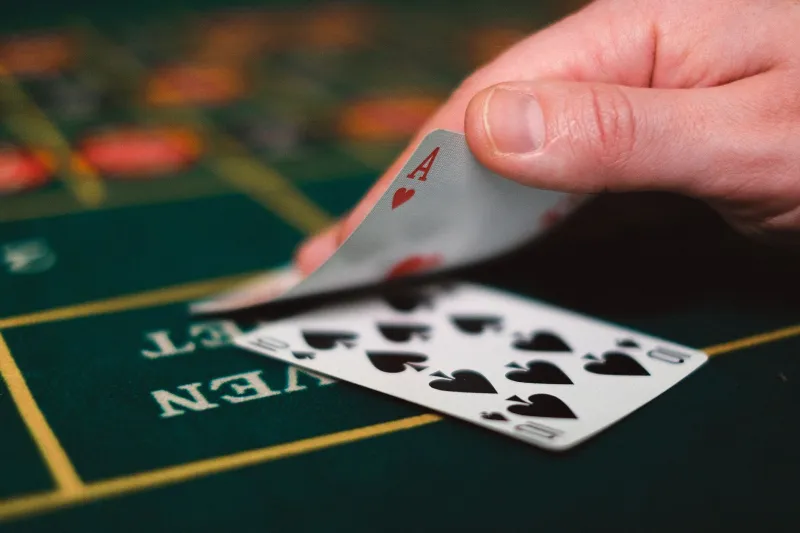
When the dealer's upcard is an Ace, the casino offers you the chance to bet up to half your original wager that the dealer has a ten-value card in the hole, completing a blackjack. If they do, the insurance bet pays 2:1, which washes out your original hand loss. If they don't — which happens more often — you lose the insurance bet and the hand plays out normally.
The house frames this as protecting yourself. It's not protection. It's a side bet with its own independent house edge.
Here's the math in a standard six-deck shoe: there are 96 ten-value cards out of 312 total cards. The odds of the dealer having a ten in the hole are roughly 30.7%. For insurance to break even, you'd need that probability to be 33.3% — one in three. It isn't. The house edge on insurance in a fresh six-deck shoe sits around 7.5%. That's slot machine territory. Worse than most other bets on the casino floor.
Why "Even Money" Is the Same Trap With Better Packaging
If you have a blackjack and the dealer shows an Ace, the casino will offer you "even money" — a guaranteed 1:1 payout instead of the usual 3:2. This feels like a smart, safe move. Lock in the win. Don't risk the push.
It's insurance in a tuxedo. Mathematically identical. You're giving up the expected value of your blackjack — which, factoring in the probability of a dealer blackjack, is actually higher than 1:1 — in exchange for certainty. Casinos love selling certainty. Certainty is almost always overpriced.
Decline even money the same way you decline insurance. Every time.
So When Does the Math Actually Change?
This is where things get genuinely interesting, and where most basic strategy guides stop short.
Insurance becomes a mathematically positive bet when the true count — the card counting metric that adjusts the running count for remaining decks — reaches approximately +3 or higher. At that point, enough low cards have left the shoe that the remaining deck is disproportionately rich in tens. The actual probability of a ten in the hole crosses that 33.3% threshold, and insurance shifts from a losing bet to a positive expected value play.
Card counters specifically watch for this. It's one of the "indices" — deviations from basic strategy triggered by specific count values — that experienced counters use to squeeze additional edge out of the game.
But here's the critical context: this only matters if you're actually counting cards accurately, tracking the true count correctly, and playing in a game with conditions favorable enough to make counting worthwhile in the first place. For everyone else, the count isn't +3. You just don't know what it is. And betting on a probability you can't measure isn't strategy — it's hope with extra steps.
The Deck Composition Scenario
There's one other edge case worth mentioning, mostly because it illustrates how the math works rather than as practical advice.
In a single-deck game, the composition of remaining cards can occasionally create situations where insurance has positive expected value even without a formal counting system — if you've been paying close enough attention to what's already been played. If the first round of a single-deck game has burned through a disproportionate number of low cards and you can see that the remaining composition is ten-heavy, the logic holds.
Single-deck games are increasingly rare on American casino floors, and the ones that exist often come with rules compromises — like 6:5 blackjack payouts — that eat up any advantage you might gain. But the mathematical principle is real.
The 99% Rule and Why It Holds
Let's be honest about who's reading this. The overwhelming majority of blackjack players in America are not card counters. They're not tracking true counts, they're not playing single-deck games with favorable rules, and they're not operating with the kind of disciplined, distraction-free focus that meaningful card counting requires.
For those players — and there's no judgment in that, most of us are in that category — insurance is a consistent drain. It feels like smart play because the casino presents it as protection. It sounds reasonable because "the dealer might have a ten" is technically true. But feelings and sounds don't beat math at the blackjack table.
The reason the standard advice is so emphatic is that the exception requires so much infrastructure to exploit that teaching it without the full context just creates more people making bad bets with misplaced confidence.
What This Tells You About Blackjack More Broadly
The insurance question is actually a useful lens for understanding how blackjack works at a deeper level. Almost every "always" and "never" in basic strategy has an asterisk attached to it — a specific set of conditions under which the rule bends. Basic strategy is the correct play averaged across all possible remaining deck compositions. When you have information about the actual composition, the optimal play can shift.
Card counting is, at its core, just a systematic way of gathering that information. Insurance being the clearest example of a count-dependent play is why it shows up in almost every discussion of counting fundamentals.
Understand the exception, and you understand the rule better. Just don't use the exception as an excuse to make the bad bet.